Here’s the honest answer, before the caveats: the Acatenango hike is hard, and the overwhelming majority of people who attempt it make it to the top. Both of those things are true at once, and most online accounts only tell you one. One blogger calls it the hardest thing they’ve ever done; the next shrugs it off. The truth is that Acatenango is challenging in specific, predictable ways, and once you understand them, you can decide honestly whether it’s right for you, and prepare so that it is.
We guide this hike out of Antigua year-round. We’ve walked up with marathon runners who struggled and with nervous first-timers who cried at the summit (the good kind of crying). Fitness helps, but it’s rarely the deciding factor. What matters more is knowing what you’re walking into. So let’s break the difficulty down into its real parts.
The three things that make Acatenango hard
1. The altitude
This is the big one, and it’s the factor people underestimate most. The summit sits at 3,976 meters (13,045 feet). Base camp, where you sleep, is around 3,600 meters. At that elevation the air holds roughly 40% less oxygen than at sea level. You’ll feel it as breathlessness, a slower pace, and possibly a mild headache or trouble sleeping. Crucially, altitude doesn’t care how fit you are, a strong athlete arriving straight from sea level can feel it harder than a casual hiker who’s been a few days at elevation. Spending a night or two in Antigua (around 1,500 m) or Guatemala City beforehand helps your body adjust.
2. The steep, relentless start
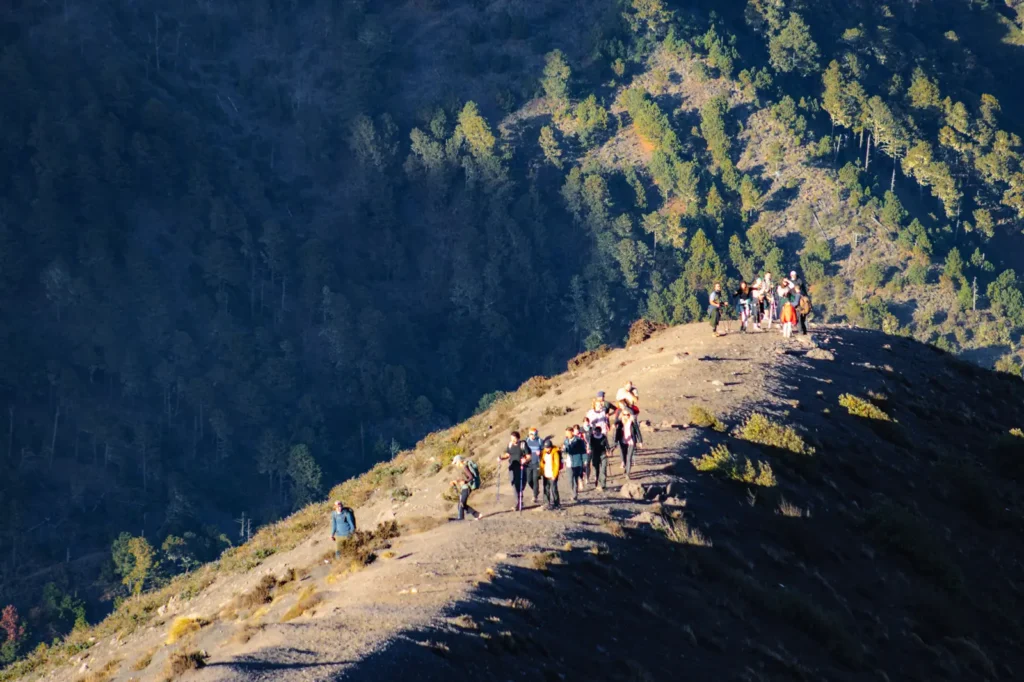
Acatenango doesn’t ease you in. The first hour or two, climbing out of the farmland near La Soledad, is steep, loose, and sandy, and it’s where most people privately wonder what they’ve signed up for. There are no flat recovery sections to speak of; the trail simply goes up. The good news: once you settle into a slow, steady rhythm and your body finds its pace, it becomes manageable. Pacing, not power, is what gets you up.
3. The summit scree (and the descent)
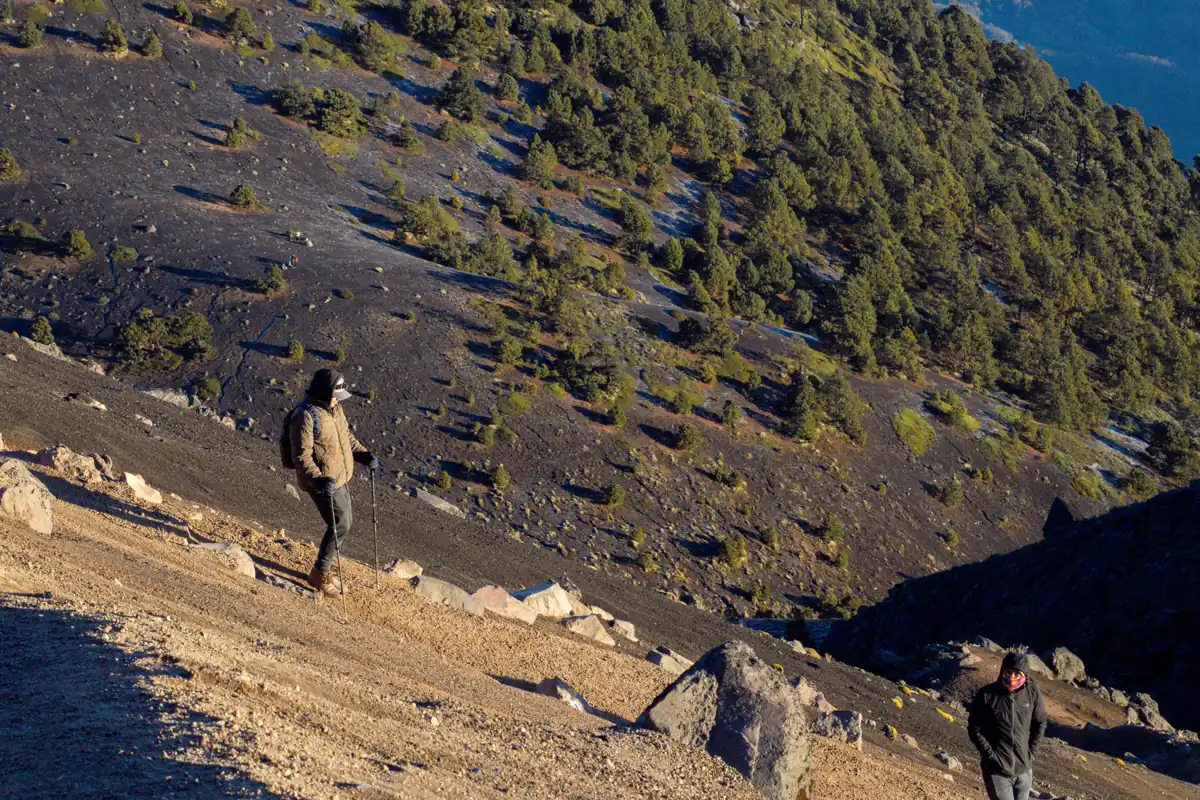
The optional pre-dawn push to the true summit climbs about 300 meters up loose volcanic scree, two steps up, one slide back. It’s the most physically demanding hour, in the cold and dark. And the descent on day two, while it doesn’t tax your lungs, hammers your knees and quads on the same loose ground. This is where trekking poles earn their keep.
So how fit do I need to be?
You do not need to be an athlete. You need to be able to walk uphill for several hours at a slow pace, carrying a light daypack, without your knees or heart giving you trouble. A useful self-test: can you comfortably climb 60–90 minutes of stairs or steep hills near home, taking breaks as needed? If yes, you can almost certainly do Acatenango with the right pacing and preparation.
Be more cautious if you have a heart or respiratory condition, are recovering from injury, or have had altitude sickness before, in those cases, talk to your doctor first. Acatenango is not technical (no ropes, no climbing skills), but it is sustained, high, and cold, and it deserves respect.
What the hike actually feels like, hour by hour
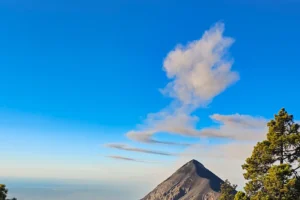
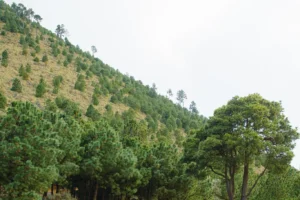
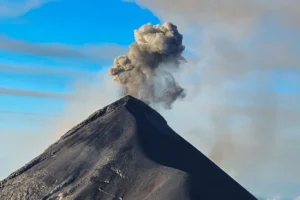
It helps to know the shape of the effort. Day one: you set off from the trailhead in the early afternoon and climb roughly 4 to 6 hours to base camp, gaining around 1,500 meters through four distinct ecosystems, farmland, cloud forest, alpine forest, and finally the bare volcanic slopes. The first stretch is the hardest; it eases (relatively) as the gradient relents higher up. You reach camp in time to watch neighboring Volcán de Fuego erupt, often every 15 to 20 minutes, throwing glowing rock against the dusk. Day two: an optional 4 a.m. summit push in the cold for sunrise over the volcano, then breakfast and the long descent back down, generally easier on the lungs, harder on the legs.
How to make Acatenango easier (the operator’s playbook)
This is the part the travel blogs can’t give you, because it depends on the operator. Here’s how our guests lighten the load:
Take the 4×4 to base camp
The single biggest difficulty-reducer we offer is the 4×4 Basecamp Ride. It carries you and your gear up the steepest, sandiest lower section ,the part that breaks people, so you arrive at base camp with energy in reserve for the summit. If the day-one climb is your worry, this changes the entire experience.
Hire a porter or pack light
Less weight on your back is less strain on your lungs and knees. Carry only the essentials (see our packing list) and consider a porter for the rest.
Pace slowly from the first step
The classic mistake is starting fast on the steep opening and burning out. Go slower than feels natural. “Pole pole,” as mountain guides everywhere say.
Use trekking poles
We provide them on request. They take load off your knees on the climb and are genuinely a knee-saver on the loose descent.
Acclimatize and hydrate
A night or two in Antigua beforehand, plenty of water on the trail, and a light, carb-friendly lunch before you climb all help your body cope with altitude.
Lean on your guide
Our guides set the pace to the group, carry first aid, and have walked this mountain hundreds of times. Tell them how you’re feeling, that’s what they’re there for.
A simple way to prepare in the weeks before
You don’t need a structured training program to enjoy Acatenango, but a few weeks of light preparation makes a noticeable difference, especially on the descent, where unprepared legs suffer most. If you have three to four weeks before your hike, here’s the low-effort plan we suggest to guests who ask.
Build leg and lung endurance
Two or three times a week, do something that gets you climbing for 45–60 minutes, stairs, a stair machine, a hilly walk, or a steady jog. The goal isn’t speed; it’s teaching your legs and heart to keep working uphill without stopping. If you live near hills or a tall building with stairs, that’s your gym.
Practice going downhill
This is the step most people skip and then regret. Walking down hills or stairs trains the quad muscles that take the pounding on Acatenango’s loose descent. Even a couple of downhill sessions reduces next-day soreness dramatically.
Walk in your hiking shoes
Wear the exact footwear you’ll bring on the hike for a few long walks beforehand. This breaks them in and surfaces any blister hot-spots while you can still do something about them.
Arrive a little early and acclimatize
If you can, spend a night or two in Antigua (around 1,500 m) before the hike. It’s the single easiest thing you can do to blunt the altitude, and it happens to be a wonderful place to spend a couple of days.
None of this needs to be intense. Consistency over a few weeks beats one heroic gym session the day before, which will only leave you sore on the trail.
Is it worth it?
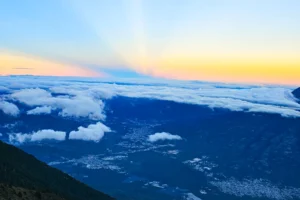
We’re not neutral, but we’ll let the experience speak: you spend a night on the shoulder of one volcano watching another one erupt against the stars, then climb into a sunrise above the clouds with Guatemala’s highlands spread beneath you. Ask almost anyone who’s done it and they’ll tell you the difficulty is exactly what makes the payoff land. Hard, yes. Unforgettable, also yes.
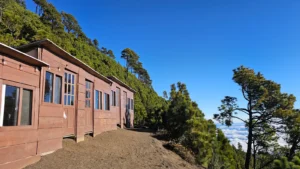
If you’re on the fence, that’s normal, most of our guests were too. The honest path forward is to prepare properly, choose the options that fit your fitness, and back yourself. When you’re ready, the Acatenango overnight hike includes the cabin, meals, and gear, and our team will get you up there.
Frequently asked questions
How hard is the Acatenango hike on a scale of 1 to 10?
For an average traveler arriving without altitude acclimatization, most rate the day-one climb a 7–8 out of 10, mainly because of the steep start and thin air. With the 4x4 ride to base camp and good pacing, many would call it a 5–6.
Can a beginner hike Acatenango?
Yes — plenty of first-time hikers summit Acatenango every week. Beginners do best when they pace slowly, pack light or take the 4x4 ride, spend a night at altitude in Antigua first, and go with guides. Technical skill isn't required; steady effort is.
How long and how high is the Acatenango hike?
Day one is roughly 4–6 hours of climbing to a base camp near 3,600 m, gaining about 1,500 m. The optional summit push reaches 3,976 m (13,045 ft). Day two is mainly the descent.
Will I get altitude sickness on Acatenango?
Some people feel mild symptoms — headache, breathlessness, poor sleep — at base-camp altitude. Serious altitude sickness is uncommon on an overnight at this elevation, but it's possible. Acclimatize beforehand, hydrate, ascend slowly, and tell your guide if you feel unwell.
Is the descent harder than the climb?
It's easier on your lungs but harder on your knees. The loose volcanic ground is slippery, so trekking poles and decent footwear make a big difference on the way down.