Shooting the Eruptions: A Field Guide
Acatenango offers one of the most photogenic scenes on Earth: a volcano erupting glowing rock into the dark, and a sunrise above the clouds. But it’s also a hard shoot — cold, dark, and fast-moving. Here’s how to come home with images that actually capture it, whether you’re on a phone or a camera.
Before you go: the essentials
Cold destroys batteries, so bring a power bank and keep your phone or camera warm in an inside pocket. Clear your storage before you arrive — between the dusk eruptions and the summit sunrise, you’ll shoot more than you expect. A small, sturdy tripod is optional but transforms your night shots.
Shooting the eruptions at night
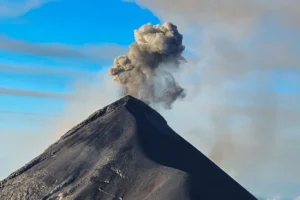
Eruptions happen every 15 to 20 minutes, so you get many chances — but each burst is brief. The key is a long exposure to capture the glowing arc of rock against the dark.
On a camera
Use manual mode: a 2–8 second exposure, aperture around f/4–5.6, ISO 800–1600, and manual focus set to infinity. A tripod is essential at these shutter speeds. Frame wide to include the cone and the star field above it.
On a phone
Use Night mode, or a long-exposure app, braced on a rock or tripod. Tap to lock focus on the cone, and shoot in bursts timed to the eruptions. Modern phones do remarkably well here with a steady surface.
Shooting the sunrise from the summit
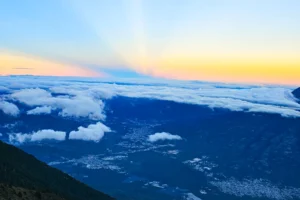
The summit sunrise is a different challenge — huge dynamic range between the bright sky and dark foreground. Shoot slightly underexposed to keep the sky’s color, then lift shadows later. Include a person or the ridge for scale; a sea of cloud with Fuego erupting below is the signature Acatenango frame.
Don’t forget to look up from the lens
The best advice we can give: don’t spend the whole night behind a screen. Get your shots, then put the camera down and just watch. Some of the best moments on Acatenango are the ones you experience directly. When you’re ready to capture your own, book the Acatenango overnight — and bring the power bank.
Frequently asked questions
What camera settings work for Fuego’s eruptions?
A 2–8 second exposure, f/4–5.6, ISO 800–1600, manual focus at infinity, on a tripod. Time your shots to the eruption bursts.
Can you photograph Acatenango with just a phone?
Yes. Use Night mode or a long-exposure app, brace the phone on a tripod or rock, and shoot in bursts. Bring a power bank — cold drains batteries fast.
Do I need a tripod for Acatenango?
Not required, but a small one dramatically improves night eruption and sunrise shots by allowing long exposures without blur.